
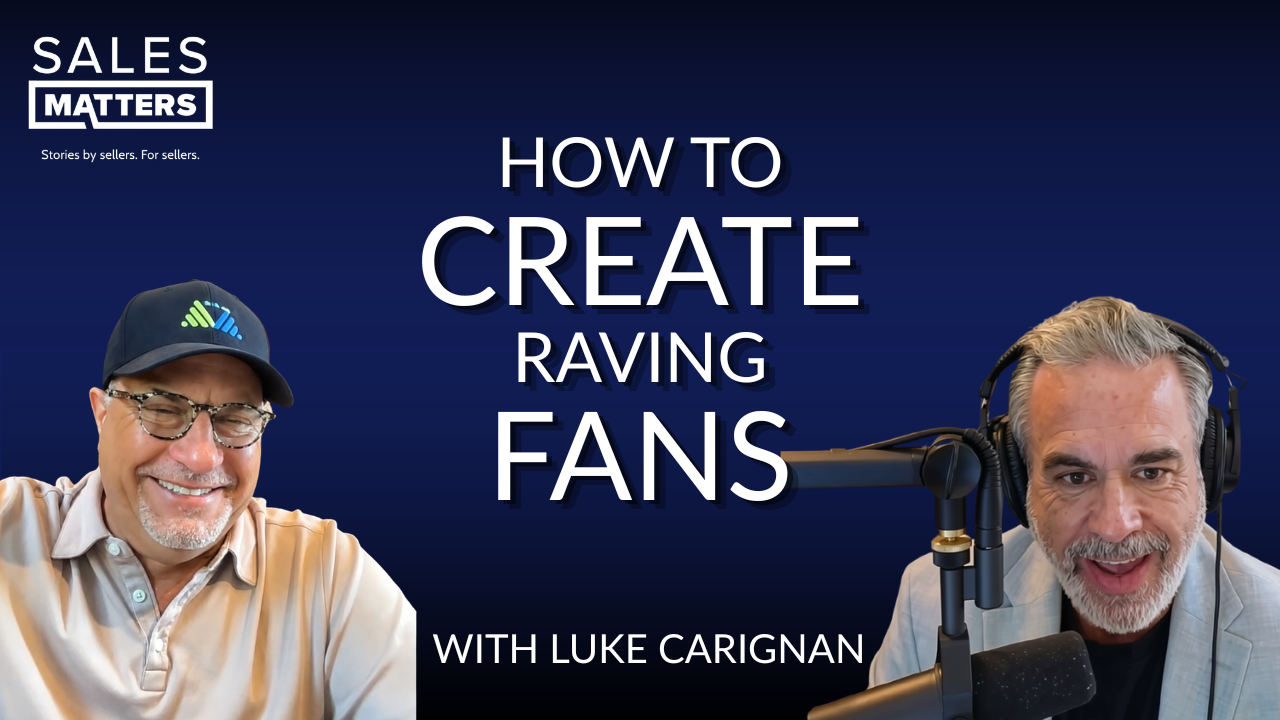
"I think it's more important to learn how to do your target's job than it is to learn about your own product." Luke Carignan went from waiting tables in Chicago to hitting quota every quarter for seven and a half years selling to healthcare talent acquisition leaders. He tells host Tim Geisert why learning your buyer's job matters more than knowing your product, how asking for mentors changed his career, how he keeps his pipeline healthy, and why creating raving fans means you never have to cold call.


[00:00] Luke Carignan: I think it's more important to learn how to do your target's job than it is to learn about your own product.
[00:08] Tim Geisert: A lot of people think sales is easy. They're not the ones carrying a number. Yes, sales is a rewarding profession, but it's filled with ups and downs, yeses and many nos. The successful ones have a secret: they have a plan, a belief, something special that keeps them going. We find those sellers and revenue leaders, we hand them the mic, and we learn from what they've learned. Hi, I'm your host, Tim Geisert, and this is Sales Matters — for and by the people who deliver a number.
[00:39] Tim Geisert: For our audience today here at Sales Matters, we've got Luke. Luke, why don't you tell us about you, what you do, and give us the 411 on Luke.
[00:51] Luke Carignan: All right, the 411 on Luke Carignan: the most obsessed healthcare talent acquisition professional you'll ever meet in your life. And I'll tie it back to why I'm the most obsessed, because I've got facts to back that up.
So I'll tell you how I got into sales. I was probably 25, 26 years old, living in Chicago, waiting tables. I never went to college — I only have a high school diploma. I met a great girl who's my wife now, and she basically got to the point where she was like, "You can't wait tables forever." And I wanted to, Tim! In downtown Chicago, you can do very well. This place was across the street from CareerBuilder.com's headquarters at the time, so I basically just begged them for a job. Finally, they gave me one. I was cold calling — like 300 cold calls a day — and I got promoted six times in three years. From there I went to Monster, then ADP, and then started my own healthcare staffing firm. So this gets to why I'm the most obsessed healthcare talent acquisition person on earth.
I ran that for seven years with a couple of buddies. At our heyday we were probably around 30 employees, with about $5 million in revenue. But it's a roller coaster owning your own business. You've done it, Tim — hats off to you, because it's hard. It's feast or famine.
[02:10] Tim Geisert: Oh my God, it really is.
[02:12] Luke Carignan: It's exciting and scary every other minute. And I learned so much about myself. I learned that I don't like managing people. I absolutely hate it. I'm really good in sales. I'm an excellent individual contributor. I just don't want to deal with anybody else's junk, you know? So I went over to Phenom, and I started the ASHHRA podcast — the American Society for Healthcare Human Resources Administration. We've had over 250 episodes. It's where I get all of my leads, and where I sharpen my craft for selling to the healthcare industry. And the girl who told me I couldn't be in restaurants anymore — that's my wife. She was a healthcare HR director at the health system in our city. Now we've got two little healthcare HR babies running around the house.
[02:58] Tim Geisert: So you guys have t-shirts for the family?
[03:01] Luke Carignan: We should. I need to get that made. I absolutely need to get that made. So yeah, that's my background. Claim to fame: I've got something I just looked up the other day. You're going to like this, with sales. I don't know if this record exists anywhere else, so I'm going to toot my own horn. I haven't missed a quarter in seven and a half years. Not "missed quota" — I've always hit quota. Seven and a half years of not missing a single quarter. So proud of it. I just looked it up yesterday.
[03:34] Tim Geisert: So, okay, let's unpack that. The average seller or sales professional or producer — whatever name you want to go by — would be envious of that.
[03:47] Luke Carignan: Absolutely.
[03:48] Tim Geisert: How do you do it?
[03:49] Luke Carignan: You know, it's easier than it sounds. You just have to be a master of your own craft and of who you sell to. The bottom line is that you've got to be able to do the job of the person you're selling to. I think it's more important to learn how to do your target's job than it is to learn about your own product. Because let's be honest: at most companies, you have a team of people behind you, a lot of folks who are willing to help. All you have to do is give them a call or shoot them a Slack message, and they'll jump on and help you out. So you have to ask yourself: is your product knowledge really your most valuable asset? I don't think it is. I think softer skills — reading the room, working with empathy, having a high EQ — matter. But at the end of the day, it's understanding how they do their job, because they're selling whatever you're selling to somebody else. It's got to not only make them better but drive the business forward.
[04:52] Tim Geisert: Okay, so look, this is really interesting. I've done a bunch of these, and this has never come up. People say, "Oh, you've got to understand your customer, you've got to understand the buying committee," especially in B2B sales. What you're saying is you need to really figure out what their job is and what they need to do. So give us an example of how this has panned out for you.
[05:21] Luke Carignan: Yeah. Typically we're selling to talent acquisition, so I'll speak through the lens of a VP of Talent Acquisition in HR. When I owned my own staffing firm, I ran a team of recruiters. When I came to sell to people like that, I immediately realized, "Oh, I've got a competitive advantage here, because I've already run a team. So what would I want to see? What would make me more money?" Since the buck stopped with me and it was my company, I had to make money. I wasn't trying to pick up efficiency somewhere; we were trying to make dollars.
And another thing dawned on me — I think this will be really good for the listeners: ask for mentors. I became successful because I would ask for mentors who I thought would never say yes. And spoiler alert: every single one of them said yes, even if it was just 30 minutes a week.
[06:12] Tim Geisert: So who is one of your best mentors?
[06:14] Luke Carignan: Hands down, Joyce Russell. Are you familiar with her at all? She's the former CEO of Adecco — a $20 billion staffing firm, one of the biggest in the world. I had met her at a conference, and I actually had her on a podcast — we also have The Bo and Luke Show. She was a guest on there, and she was absolutely incredible: one of the most outgoing, infectious personalities I've ever met in my life. And I was like, "Man, if I could just be like Joyce." So I picked up the phone and called her and said, "I know you've got a lot going on, and you don't have to say yes to this, but would you mentor me?" And she said, "Yeah, I'd love to." So every Friday at 10:30 a.m., we had a standing call for 30 minutes. On the first call, I told her what I was dealing with, and she said, "Okay, here's what I want you to do. Do it over the next week, and then we'll talk next week." And Tim, I'd do it, and it would work. You ever do something someone tells you to do and it just works immediately?
[07:17] Tim Geisert: Yeah.
[07:18] Luke Carignan: So then I had an epiphany: why am I being creative? I have all these people around me who have already done it. In my mind, I'm like, "Oh, I can think of a better way to do it." No. Ask somebody who's already done it. So I just kept going down that rabbit hole: "If I'm going to try something, who's doing it the best in the world right now? Let me reach out to them and see if they'll say yes." And the successful people all want to help.
[07:47] Tim Geisert: Yeah. And that's another form of — you've heard this — ROI. It's not return on investment; it's "rip off and implement," or "rip off and imitate," right?
[07:55] Luke Carignan: Yes.
[07:56] Tim Geisert: That's great. Did you just figure that out? Were you just curious? You didn't read it in a book?
[08:01] Luke Carignan: Yeah, I wish I would have figured it out a decade earlier. I'm kind of kicking myself that I was so stubborn that it took me that long to stumble upon that nugget.
[08:11] Tim Geisert: So, speaking of that, what are some of the other things you'd tell your younger self if you could, knowing what you know today?
[08:21] Luke Carignan: Don't slack on pipeline, ever. It is important. You need to figure out how many deals you need in the pipeline to kill it, and how many you need just to hit your quota. For me, if I have under 15 deals in my pipeline, I start to freak out, Tim. I want to be comfortable — between 15 and 20. Over 20, I know I'm going to kill it. And I treat it like a garden, too. I don't want weeds in my garden, right? If there's a weed, I'm going to pull it out. These have to be 15 to 20 beautiful flowers that will bloom at some point. And if they're not, get them out of there, because then you're just lying to yourself, you know? And you'd be shocked at how much better you can get by watching YouTube videos for 15 minutes at 8 a.m. every morning. Do that for an entire quarter, and you will be better than 90% of your sales peers out there, because they're just flat-out not doing it.
[09:19] Tim Geisert: I want to go a little bit further in articulating this idea of doing the person's job. Use an example of how you learned that, then applied it, and then sold something. I want this to be something very practical our listeners can take away. And as you and I know, a good client story is the best way for them to retain it.
[09:45] Luke Carignan: Yep. I do it every day, and the simplest way I can do it is asking somebody about their talent acquisition process. Reps don't know how to do the job, so they don't know the questions to ask. I start very high level, and it doesn't even look like I really know how to do their job. Tim, it's so simple. I'm like, "Okay, how many people do you have on your team?" They're like, "Oh, we have fifty." "Okay, great. How's it split up? Do you have sourcers? Do you have recruiters? Do you have coordinators? Tell me about what they do." So they tell me how it's divided up. Then I get deeper: "Okay, do you run an assembly line? Are they all full desk? Or is it a hybrid, where you have some assembly line for high-volume roles and full desk for more targeted roles?" And they'll give me that information.
The reason that's critical for the way we sell our product is that if you try to sell a full-desk solution to an assembly-line company, it's just not going to land. They're not going to know what you're talking about, and the rep isn't going to know what they're talking about. It's the same product — the exact same thing — it's just how you show it to that person, based on how they do their job.
Another thing we've got to understand about how they do their job is how they're measured and graded. Because I'll tell you right now: what we sell at Phenom, we're always the most expensive in the market. Always. I think we're the best; I think we're innovating quicker than anybody else, and we bring the most value. But if you don't know how to do their job and can't identify the business outcomes for them, no one's going to break out their checkbook for that. So what ends up happening is reps go and look for efficiencies — recruiter comforts, maybe making the leader more comfortable in their job. But guess what? When it gets to a CFO or a COO, nobody cares one bit. They couldn't care less about the comfort of the recruiting team. They're not trying to hear efficiency. They're trying to hear how profitable the next hospital they're opening up will be. They're trying to see how they can reduce travel nursing and save $100 million. How can they take a razor-thin margin of 1.2% and get it to 5%? And if you can't connect those dots by understanding how they do their job, you're just feature-function selling. I don't think you can hit quota that way — not every quarter, not every year. I mean, you can get lucky, but...
[12:08] Tim Geisert: So let me ask you this, based on what you've learned in this whole thing — and I don't know if this is the right way of saying it — how much of what you do is drawing on the emotions of a person, versus their rational reasoning and decision-making?
[12:30] Luke Carignan: I'd say it's 90% emotion, 10% decision.
[12:33] Tim Geisert: Really? Even with what you just said — you're laying out all the business reasons. Talk to me about that.
[12:40] Luke Carignan: Yeah, people buy with their heart. Just like with anything else, they buy with their heart. First of all, they've got to like you, right? So just being likable might be one of the biggest things you can do, besides knowing how they do their own job. But it allows you to get passionate about it with them, right? If you're not passionate about it with them, why would anybody buy from you? There's a level of comfort where, if the prospect and I are both so passionate about what we're doing on each side that we're willing to pound on a table to get the other person to see it our way — that's a win. That's a win every single time. There's got to be that emotional connection. And everyone's got it. Even the most hardcore people, who look like they don't even want to be in the meeting — they've got it. And there are a couple of questions you can have in your back pocket just to get them to open up.
[13:33] Tim Geisert: Give me an example.
[13:35] Luke Carignan: A go-to would be — all right, it's healthcare. So I'll look at their background and ask them a specific question. Not "What made you get into healthcare?" No: "What was the moment you knew this was the right industry for you?"
[13:53] Tim Geisert: That's a cool question. That's a great question.
[13:55] Luke Carignan: Right? Because now I'm asking, "What is the one moment?" And they usually pause, right? Or just compliment them and then ask them a question: "Wow, you're so detailed. This is something to behold — game recognizes game, and I like this. What's the one biggest thing you learned from your parents that you think made you so detailed?" That's a crazy question to ask, and it gets people thinking. It gets them to open up to you. It's got to be personal.
[14:25] Tim Geisert: Yeah. Well, speaking of personal: how is sales personal to you?
[14:31] Luke Carignan: I mean, it's my life. Right? It's my life, and I love it. I wouldn't do it for free, I'd say, Tim. But I absolutely love it.
[14:39] Tim Geisert: But what has it done for your life? Talk me through that.
[14:47] Luke Carignan: In every single aspect. I can start with the money. So I got a paycheck a couple of months ago — and I pulled it up on my phone, because they don't actually give us checks anymore, right? — and I walked in to my wife and showed her, and I said, "Would you believe that for a two-week period, this check was worth five times more than I used to make in a year when you met me?" For a two-week period.
Okay, that's one way. Another way, with money: we have three kids now, the youngest six and four. My wife doesn't have to work now; she gets to stay at home with the kids — which, by the way, the way I look at it, is the ultimate career. The ultimate career is raising our families. She's got the ultimate career. She's raising little humans. And gosh, taking care of me is practically a full-time job in addition to that.
[15:43] Tim Geisert: But it sounds like it gives a great return on investment.
[15:45] Luke Carignan: But yeah, no — the way I look at it, all this other stuff that we do is to support the ultimate career that she has. And we shouldn't get it twisted. And I'd love to talk about the efficiencies that go into this, too, if you'd let me. This is one of the best parts about being in sales, and why it's personal to me: for what I'm able to bring in financially, there is no other career on the face of the earth where I'd get this much time with my family, my kids, my wife. In order to pull this kind of cash, you'd have to be working 80 or 100 hours a week, and we just don't.
It always bothered me, Tim. In our society, we work toward retirement. People are willing to work 80 or 100 hours a week and never see their wife and kids. They reach it, they have the money — and then everyone's left. Everybody is off, and you don't get to enjoy it with anybody. And I always thought about that. I'm like, how can I engineer my life and my career so that, sure, I'm not retired, but I get pretty close to enjoying the game with them?
[16:57] Tim Geisert: Yeah. You sound like the kind of guy who plans these sorts of things out. Did you say, "Okay, sales — here's how I want to do it, and I want to make it a blend of my life experiences and my work experiences"? I'm putting words in your mouth, but is that how you did it?
[17:15] Luke Carignan: It's exactly right. Everything I do is like tributaries — little streams flowing into a river, right? I have the healthcare podcast, and that flows into my lead generation for the sales that I do. Any mentoring I do all goes into healthcare HR as well. We also started a nonprofit with Corey, the co-owner of the staffing firm I had, and my co-host Bo Brabo, who's a veteran. It's Valor Path, and we're focusing on skills for transitioning veterans, to reduce veteran suicide. Because the number one reason for veteran suicide is feeling like they're a burden on their friends and family because of money. That also flows into my healthcare HR work. So I've got all of these things going together. I'm doing separate things, but they're all going in the same direction, and they feed off each other, and I learn from everything around them. It allows me to have that robust pipeline and all the robust connections, but with a lot less work and a lot more intention.
[18:27] Tim Geisert: I mean, this is good stuff, Luke. There are going to be a lot of takeaways from this. I am curious, though: before you even knew you wanted to be in sales, what did you do to make money when you were young?
[18:41] Luke Carignan: Yeah. I want to say fifth grade. My dad taught me how to make what he called a fart machine. What you would do is take a coat hanger and cut it so it looked like a small bow and arrow. You take two rubber bands and a metal washer, you put one rubber band on each side, put the metal washer in the middle, and you twist it up. So he showed me how to make this, and I just thought it was hilarious. You could put it on a leather chair, right under your leg, and lift — and it sounds like you just let one rip. I laughed so hard. I loved it.
So I went into his toolbox and got all the metal washers I could find, and I started cutting up coat hangers. I had time on my hands — I'm in fifth grade. I'm sure my stepmom hated it, because we had no hangers left. I got all the rubber bands, and I probably made like a hundred of them. I took them to school and was selling them for a dollar, and people were giving me their lunch money, and it was catching on. So I got called to the principal's office. My dad's in sales too, by the way. They said, "Hey, we need to talk to you about Luke. He got caught selling — are you familiar? — the fart machine." And my dad was like, "Oh my God, this kid." So that was my first.
[19:57] Tim Geisert: He was both ashamed and proud at the same time, right? What did you learn from that that's still true today — that you found to be a truism?
[20:08] Luke Carignan: You're going to fail to sell something people don't want. I'll tell you that. That's number one for sales folks out there: if you're working for a place where you don't believe in the product and other people don't want it, what are you doing? You've got to go find something that people definitely want.
[20:20] Tim Geisert: Yeah. That's great. Here's a couple of other things — we're going to make this a little longer, because there's something we talked about in preparation for this that we haven't talked about yet. You have a mantra. I think it's "Creating Raving Fans."
[20:39] Luke Carignan: Yeah. I've got it right here on a sticky note. It sits right on my desk all day. That's like eight years old, by the way.
[20:49] Tim Geisert: So what is that about?
[20:51] Luke Carignan: Creating raving fans is what this job is all about. That's how you don't ever miss a quarter. That is my only job: to create raving fans for what we do. And that feeds everything I do. I keep it in the back of my mind in every conversation I have. If what you're selling them will not create a raving fan, you won't have a successful career.
Here's the whole idea, for other salespeople or leaders listening: nobody wants to make a cold call. I think cold calling is dead anyway. I don't think anyone wants a cold email — half of them are written by AI right now anyway. If you want to make a lot of money and you don't want to work 100 hours a week, you need a steady stream of business coming to you. That's the only way you can do it. There's no way around it. And to do that, most people say referrals. I think it even goes beyond referrals: you need people who hear about you, where you're brought up in a conversation and then they reach out to you directly.
I'd say if you're working a partnership and you don't think it would create a raving fan, I'd even go as far as telling the prospect, "Hey, I just have a feeling that this isn't for you." I've done that before. And guess what? Six months later, either they come back when it is right for them, or they appreciate it so much — it happens all the time — that somebody else calls me and says, "Hey, I was talking to Tim. It didn't work out with you guys, but I think it'd be a good fit for us. Do you think we could have a conversation?"
And then at the end, Tim, when it comes to selling, I have so many references I can give people. I'm like, "Don't take a sales guy's word for it. I've got a line that goes out the door and wraps around the building twice of people who are getting a great experience with this. And guess what? You can talk to them. They're happy to talk to you." Without creating raving fans, you get none of that. Absolutely none of it. So I think that's the barometer of what I do: am I going to create a raving fan?
[22:54] Tim Geisert: You know what I like about it? To use your analogy of tributaries flowing into a larger river: there are a lot of tributaries that feed into that outcome. If I'm creating raving fans, I have to deliver. I have to be honest. I have to create excitement. I have to prove that it works. And they have to trust me, right? And I think many times in sales we think, "Well, we've got that one won and that deal done; let's go on to the next." And the fact of the matter is, it's a cumulative effect, isn't it?
[23:27] Luke Carignan: That's right. You can't do that. You've got to call and check on people. When something goes wrong — guess what? It's your mess. I don't care if it went to account management, or something's going on in implementation. It does not matter. You were the face of it from the beginning. Get in there. Get your hands dirty. Help out your teammates, by the way — they could be getting killed over there with complaints and things. You had all the context. Be a good team player. Come in and say, "Okay, this is what we discussed; the intent might have gotten lost here." Show up for your customers. Create a fan. Some of the best raving fans — the biggest ones — are the ones that had problems that I was able to go in and fix, going above and beyond when it clearly wasn't my job. Those are the ones that stick around and give you referrals.
[24:17] Tim Geisert: Absolutely. My good man, thank you so much for your time today. We're going to do a part two, either on your podcast or here on Sales Matters — I don't care which — and let's talk about this crazy AI thing. But for right now, I appreciate your time, your insights, and your mantra. It's one we all should follow. Good to talk to you, man. We'll talk to you later.
[24:40] Luke Carignan: Likewise. Thanks, Tim.