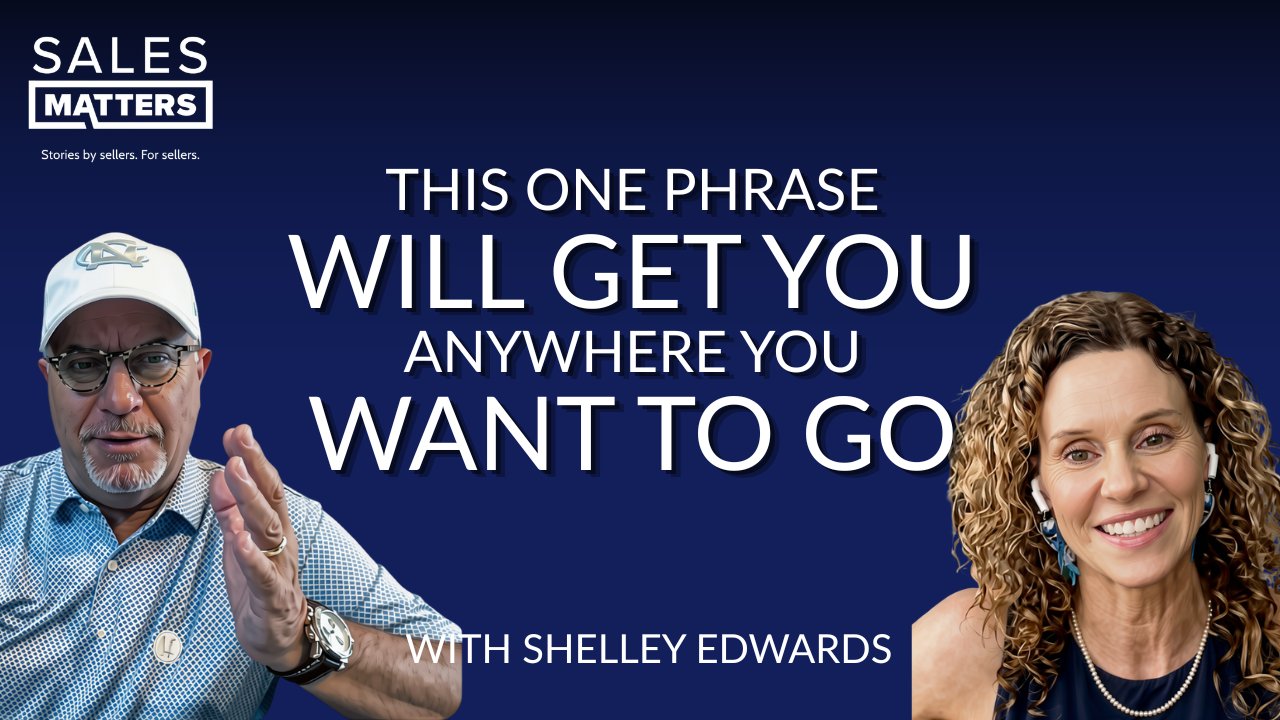
How do you earn a buyer's trust over Zoom? Phenom seller Shelley Edwards explains "informed empathy," the approach she uses to build trust in virtual sales, and why the three words "tell me more" open up any sales conversation.


[00:00] Shelley Edwards: "Tell me more" will get you anywhere you want to go.
[00:08] Tim Geisert: A lot of people think sales is easy, but they're not the ones carrying a number. Yes, sales is a rewarding profession, but it's filled with ups and downs, yeses and many nos. The successful ones have a secret: they have a plan, a belief, something special that keeps them going. We find those sellers and revenue leaders, we hand them the mic, and we learn from what they've learned. Hi, I'm your host, Tim Geisert, and this is Sales Matters — for and by the people who deliver a number.
[00:40] Tim Geisert: Shelley, guess what? I have something special for you. I wore this really nice blue shirt, right? To celebrate, I've never worn this hat in my life, and I don't know if I can. But in honor of you and NC State, I thought it would be appropriate.
[01:00] Shelley Edwards: How proud I am of you right now. And how nice do you look!
[01:05] Tim Geisert: Hey, everyone. We have Shelley Edwards here from Phenom — and some would say that she is a phenom seller. So thanks for doing this. Very much appreciated.
[01:16] Shelley Edwards: Yeah, happy to chat.
[01:18] Tim Geisert: Okay, so let's jump right in. Here's a question I always like to ask: what did you do when you were young to make money?
[01:27] Shelley Edwards: Wow. Babysitting was the way to go, right? Didn't have taxes. I was doing it anyway. My parents had this built-in babysitting system that naturally happened when they had my sister, who was six years younger than me. So at 10 years old, it's like, "Oh, well, Shelley's already got her sister. Take on one more friend. We'll pay you whatever the hourly rate was."
[01:53] Tim Geisert: So, okay, what did that teach you about selling at Phenom?
[02:01] Shelley Edwards: Well, when we talk about sales, it has this stigma of what it is. I think people initially react to sales through the analogy we hear of someone selling door-to-door stuff that you may or may not want — one size fits all, "What's it going to take to get you into this car today?" — and it seems very uniform. But real sales isn't like that. It's so personalized, right? Just like babysitting: I've got to know each of these kids, what they eat, what they don't, what's going to make them explode if the two of them interact. There's a lot of politics around babysitting and child adventures. So it's not that different from learning how to work with people, how to be a good friend, how to be someone in the room, how to anticipate some of the challenges that may come up just by knowing people. So it taught me a lot of people skills. And that's the crux of trust and relationship building, and that eventually leads to okay sales.
[03:05] Tim Geisert: Yeah, well, probably more than okay sales, given your record. Okay — "the crux of trust." Is that what you just said?
[03:17] Shelley Edwards: I think so.
[03:19] Tim Geisert: Why did you say that — "the crux of trust"?
[03:22] Shelley Edwards: Oh, look: sales is about trust. You will feel more comfortable buying something from someone who you trust. And trust isn't built because you're good at building relationships. It's built because people notice that you're paying attention. And once you've established that level of trust, everyone feels a little more comfortable. The doors are open, right? They're willing to hear you. But establishing that trust is the hard part of all of those things, and that's the tough part of sales.
[03:56] Tim Geisert: Yeah. But in this day and age, where we're selling across a Zoom — boy, that's hard to do. How do you get them in this circle of trust? I used to have a client who said, "I always love to play a round of golf, because I can see if they're a cheater or not," or how disciplined they are to the game, or what they do and don't do when things are happening away from the ball. It was kind of his psychoanalysis of the individual, but it was all about the crux of trust. So I think it's kind of interesting. So how are you creating trust in this age?
[04:36] Shelley Edwards: Yeah, it's difficult when a lot of those relationships are built virtually, right? And I wouldn't describe my style in sales as relationship selling. I think that has a different connotation, where it seems like I'm making them my best friend and bringing brownies to the meeting or something. I'm not doing that. I think of it more as informed empathy. So I invest a lot of time understanding the business: How do they make money? What's changing? What does their leadership care about? What's the company betting on? But then I invest that same amount of energy understanding the person sitting beside me or across from me, virtually or really in the room. What are they personally trying to accomplish? What are they professionally trying to accomplish? Because the lines get really blurred. What does success look like? Who are they as a person?
And I find that in this virtual day and age, who you are as a person at home, to your friends, to your family, is probably who you are in business. And I want that to be the same person — that's the most authentic and genuine form of me. It's really easy to do. If I take that same sense of curiosity that I have about my kids — "What was your day like? Tell me about that science project. Hey, I noticed that you really like playing soccer; what's it like playing with a whole new group of kids?" — you take that lens and you just shift it to business. That sense of curiosity, fueled by the information you've collected about the company and about the person you're meeting with, is more likely to spark a real conversation than the discovery questions you can find from a million different sellers across the internet, right? It's intentional, it's empathetic, it's informed.
[06:22] Tim Geisert: I was on a call like this with a customer, and this guy had the most interesting background. I finally asked him, "So, dude, what's up with the background?" And without missing a beat, he goes, "Well, I just want you to know I'm an interesting person." And I was like, okay, let's talk about that.
[06:47] Shelley Edwards: And I think that's really interesting from a psychological standpoint: we all want to be interesting, right? Things are moving rapidly. People, companies, mergers and acquisitions are going left and right, and it's easy to feel disposable. "Oh, who's the new person I'm selling to? Who's the new person in the room?" Nobody wants to feel like that, but with the way business goes so fast, it's easy for that to happen. And if you don't take the time to see the person in the person, then you've kind of missed the whole point of it all.
[07:28] Tim Geisert: So let me put you on the spot a little bit. Be the teacher here for a second for those listening in and watching. Do you have some good questions that you ask, to begin to get past that crux of trust and into trust?
[07:54] Shelley Edwards: It's not always a question, but just the phrase "Tell me more" will get you anywhere you want to go. "Hey, I learned this about your business. Seems like this is happening. Tell me more." And if you can give people the pause to do that, they will, and people will naturally go in the direction they care about. They'll say, "Yeah, that's something interesting that's going on in our business. But what you wouldn't know is what I'm dealing with now, and now I've got this boss in this situation." And as a salesperson, you've got to weave in being the therapist, right? Sometimes when you're talking to your potential buyer, they want to solve a problem. Sometimes they want to vent, and sometimes they want some help. You've got to figure out which one of those it is, but "Tell me more about that" is the key.
[08:46] Tim Geisert: Right. It's asking the five whys — getting to the why behind the why.
[08:51] Shelley Edwards: It's not a scripted question that you have to be perfect at. It's just, "Hey, that's interesting. Tell me more."
[08:59] Tim Geisert: That's a very valuable lesson for all of us in sales. You really just want to shut up and listen, right? Not the old-school "show up and throw up."
[09:07] Shelley Edwards: Right. "Let me tell you all about my blah." None of your blah matters until you know that. So, listening — it's actually how I operate my personal life, too. You try to listen more than you speak. If you're a good friend, you listen, right? And not only are you listening to hear and to understand, but you're kind of taking notes. If I talk to a friend who's interested in running, maybe I make a little mental note: "Maybe I'll send her that book by that cool podcast guy I listen to on Nike Run Club when I'm running. I think that'll be a good connection." You're doing that mentally for your friends and family. If you can do that in business, then you've really seen the magic.
I'll give you an example. There was a buyer at a large consumer goods conglomerate that I was working with and trying to onboard to our platform. And I read something about their new chief inclusion and diversity officer making an announcement: "We're going to start reporting our employee numbers and populations in these diversity buckets, in an attempt at transparency and change." I called my buyer and said, "Hey, you can do this today. This isn't a 2020-something vision. You've already got the tools on our platform to do this today." He had no idea what I was talking about. I just gave him a really cool way to impress his new chief inclusion and diversity officer. He didn't spend any more money with me; I didn't sell anything different to the company — maybe increased some adoption. But that's the win, right? And that's the crux of trust that we've now built.
[10:47] Tim Geisert: You're kind of an example of what we like to talk about, which is that sales is personal, right?
[10:53] Shelley Edwards: Yeah.
[10:54] Tim Geisert: What's the deal that you're most proud of in all of this? What did you learn from it, and what could our audience learn from it?
[11:01] Shelley Edwards: Ah, it's one I'm working through right now that I think will be something I'm really proud of. It's a business that is super complicated — it's in the manufacturing space. I've spent months trying to understand their business. In fact, while my family and I were in Scotland this summer, I actually toured their laser facility. And I met with some folks that weren't the decision-makers — users or influencers, whatever you want to call them. That approach and that sense of curiosity really started to impress the folks I was working with back stateside: that I had invested my personal time to learn more about their facility. I had folks there saying, "Do you work here? How do you know this?" But I really cared and was really excited about the business. And I didn't handcuff that. I came to presentations and drew analogies from what they're doing in their world — their laser and AI space — to what we're doing. It starts to feel kind of dorky, but they love that I was speaking their language, right? So it's about the personalization.
[12:15] Tim Geisert: Years ago, we were presenting to a heavy equipment manufacturer in the agricultural world, and we did a bunch of research on their combine. People were like, "Why would you care about the engineering in the combine? We're talking about HR stuff." And the combine had this very unique engineering trait: it was gentle but aggressive in threshing the grain. We actually used that as a metaphor when we went in to pitch the business. And it was interesting — after we had won, and we were having drinks a week or two later, I asked, "So why did you hire us?" Because I was always curious, right? They said it was the fact that we went in enough to understand what makes their product unique. It gave them an indication that there were so many more things we would notice about them — back to wanting to be noticed — and that we would fill in the gaps eventually, even though they didn't know what some of those gaps were going to be as we worked together. I thought that was an incredible life lesson on listening. And we weren't even listening to the customer; it was to the engineers, of whom they're so proud.
[13:23] Shelley Edwards: Right, and you should be. That's exactly what we're talking about, right? That sense of listening. You showed that you cared, which builds that trust. Because not only did you care enough to do the research for that meeting — what does that say about their expectations for the rest of the relationship? That's the foundation you've built, and that's the foundation they're going to take with you to the next step.
[13:48] Tim Geisert: The other question: what deal did you lose that still makes you mad? We feel the losses sometimes worse than the wins.
[13:59] Shelley Edwards: Isn't that the worst? One of the deals that we lost came down to users — the leaders letting their users make the decision. And the users said, "This seems a little bit easier, and this seems a little bit better." And I thought, I should have spent more time with them. I should have listened to them, right? Take a page from my own notebook. So that's the one that I feel. They came back around eventually, but of course, you learn those lessons quickly.
[14:37] Tim Geisert: Thanks so much for your time today, Shelley. A great lesson. What I'm taking away is this informed empathy — by asking what question?
[14:45] Shelley Edwards: Tell me more.
[14:48] Tim Geisert: Love it. Have a great day, great week. Go sell something, okay?
[14:52] Shelley Edwards: Thanks, Tim. Great to connect. Bye-bye.