
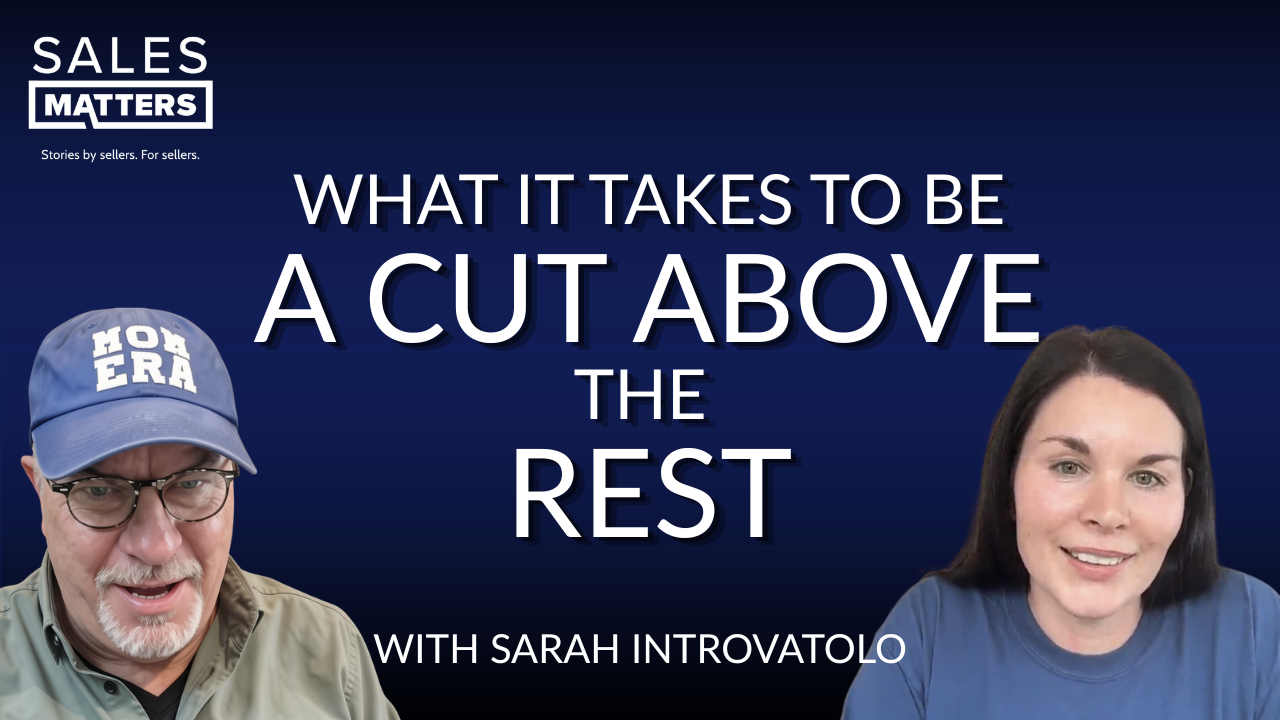
"He who talks first takes home the knives." Sarah Introvatolo sold Girl Scout cookies and Cutco knives before she sold enterprise HR software at Phenom. She shares three lessons from Cutco's training that she still uses on multimillion-dollar deals: saying "I don't know," letting silence work, and always building your network.


[00:00] Sarah Introvatolo: He who talks first takes home the knives.
[00:04] Tim Geisert: A lot of people think sales is easy, but they're not the ones carrying a number. Yes, sales is a rewarding profession, but it's filled with ups and downs, yeses and many nos. The successful ones have a secret: they have a plan, a belief, something special that keeps them going. We find those sellers and revenue leaders, we hand them the mic, and we learn from what they've learned. Hi, I'm your host, Tim Geisert, and this is Sales Matters — for and by the people who deliver a number.
[00:35] Tim Geisert: One of the things I try to do is a little bit of research. I understand you are a Taylor Swift fan.
[00:40] Sarah Introvatolo: I am.
[00:41] Tim Geisert: You are going through the mom era, is what I understand.
[00:44] Sarah Introvatolo: I actually have a sweatshirt that says "in my mom era."
[00:49] Tim Geisert: All right. Well, now when I send this to you, you're going to have both a hat and a shirt. All right, so, getting going here: tell me what you do to make money.
[01:04] Sarah Introvatolo: So at its core, I'm in software sales. Phenom does HR software. But really, I think if you talk to any salesperson, at its core you're selling, but really it's much more than that. You're a consultant for customers, doing whatever it is you do, and you try to help them solve problems. So really, I guess at its core, I'm a problem solver.
[01:35] Tim Geisert: Okay, so how long have you been doing this — solving problems and getting paid?
[01:40] Sarah Introvatolo: For Phenom specifically, nine and a half years, across a number of different roles, because I've always bounced between sales roles and enablement and training roles since 2008. But if I'm honest with myself, sales is in my blood. My dad's been a salesperson for fifty-plus years, and he always jokes that I was always the kid... I was the Girl Scout that sold the most cookies. I was the kid that sold the wrapping paper so I could get the cool prize the elementary school was giving out. I was the kid that sold sodas in the neighborhood to the workmen who were building the houses, because what else are you going to do in the summer but walk around the neighborhood and sell the workmen sodas? So really, since I was a kid, I guess.
[02:24] Tim Geisert: So why did you do that? If you dig into your heart, what motivated you?
[02:35] Sarah Introvatolo: I am just a very competitive person. Throughout grade school, and even as I started my career in sales — I think most salespeople would tell you they are competitive and type A — I'm very excited about, not necessarily beating others (I mean, that's great), but always trying to beat my best, right? Whether it's in sales, or I'm on my Peloton bike and I want to beat the last ride where I got XYZ output. So I think across the board I'm just competitive in nature.
[03:13] Tim Geisert: So your dad must have seen this in you when you were young. What else did he do to feed this budding salesperson that you are?
[03:25] Sarah Introvatolo: This was in the '90s, right? We had a house phone, and there were many times that I, as a kid, saw him on sales calls. And while he didn't specifically walk me through or train me on things like that, just being around that and absorbing some of it, I think, made a difference.
[03:42] Tim Geisert: You were learning and you didn't really know you were learning, right?
[03:46] Sarah Introvatolo: Exactly. Yeah, exactly.
[03:50] Tim Geisert: Did you just know you were going to be in sales, and that was predestined? Or did you think you were going to do something else?
[03:58] Sarah Introvatolo: I was not set on sales, right? My first real job was working retail at the mall. I was very fortunate — my parents said, "Hey, we'll buy you a car if you'll pay for insurance and gas." So the mall had an opening, I applied, and I was working at the mall, and I started nannying for our neighbors. But then I got a letter in the mail from Vector Marketing, which is the Cutco sales arm, saying, "Hey, you can make great money." I forget what the dollar value was at the time — like $15 an hour or whatever — and at the time I was making like $7 an hour at the mall, right? So this seemed like a big step up, and I figured I'd give it a shot.
[04:46] Tim Geisert: Right. This looked like a promotion.
[04:48] Sarah Introvatolo: Yep, exactly. The rest is kind of history.
[04:50] Tim Geisert: Well, this is one of the things I want to spend a little time on, because I'm a big fan of the Cutco go-to-market. It's really interesting. A lot of people don't even know about it and how it works. So I'd like you to give us a little bit of Cutco lessons from the inside, because not only did you sell, you actually then helped train.
[05:15] Sarah Introvatolo: Right.
[05:17] Tim Geisert: Talk us through that experience.
[05:20] Sarah Introvatolo: So, Vector Marketing is the marketing arm of Cutco. Cutco is made in upstate New York — amazing knives, gardening stuff, there's cookware now. It's a fantastic product. And part of the reason why I think it's so easy for them to find salespeople is because it is such a great product, guaranteed forever and all of that. And if you have a great product, it makes your job as a salesperson easier. So I think that's step one.
The training that they do is a three-day training, and it's really a crash course in sales — even though you don't necessarily realize it's such a great crash course in sales. It's everything from: how do I identify a good prospect? How do you qualify them? Through to, as you're walking through different products, how do you step down and use analogies so that customers understand, and walk them through all of that? And then they send you out to actually go make some sales. What they do a really great job of is baby-stepping all of this throughout. And then when you're actually making your first sale, if you get stuck anywhere, you can basically phone a friend and call somebody in the office who can help talk you through any challenges that you have.
[06:45] Tim Geisert: Many times as sales leaders, we just throw people into the deep end of the pool and let them go. We don't coach them, we don't teach them, we're not there to help them answer, and they fail. And then you've got to start all over, right? You've got to find somebody else. So, the baby steps — would you agree?
[07:10] Sarah Introvatolo: Absolutely. Especially if it's somebody who maybe hasn't done sales in the past, or has, but is in a new field or has a new product, whatever the case may be. Being able to baby-step it makes a big difference.
[07:22] Tim Geisert: For our listeners, what are three things — let's just pick three things — that you learned back there at Cutco that you apply to selling today, when you're selling multimillion-dollar contracts?
[07:37] Sarah Introvatolo: I always tell new folks this when they come on at Phenom: if you don't know something, say that you don't know, right? It's way better to say, "Great question, I think it's this," or "I actually have no idea, but let me go find out for you," or "Great question. I don't know — I think it's probably this, but let me confirm." That authenticity of "You've actually asked me something I've never been asked before; let me go figure this out and come back" really builds trust, and shows you're not trying to just spout whatever at a customer or a prospect. So really, just being comfortable with not knowing, and then obviously following up.
[08:22] Tim Geisert: So that's great. So that's point number one: if you don't know something, don't squander your trust. Figure it out and build trust. Okay, what else did you learn?
[08:38] Sarah Introvatolo: It's funny, because as I'm thinking about this, I'm like, it's been a long time. But one of the other pieces that they baby-step you into — so you don't necessarily even realize it — is when you ask a question that's designed to cause pain, or twist, or create that tension, right? You ask it, and then you just let it sit. They used to say, "He who talks first takes home the knives." You ask that pain question, you let them sit in that, and then answer. You let the tension... let that process happen.
[09:23] Tim Geisert: That's a great line. "He who talks first takes home the knives."
[09:29] Sarah Introvatolo: Right.
[09:31] Tim Geisert: Okay. All right, so that's number two. What's the third thing you learned from all of that that's part of your process or your thinking today?
[09:44] Sarah Introvatolo: It's not necessarily my specific role today, but just in general: it's about networking and building that network, even if they aren't a prospect or customer today. You're always putting out feelers, you're always building that network, you're always building your brand, because you never know when that person might pop up again, may actually then be in the market for whatever it is that you have, and will remember you and your brand. So just always building that network.
[10:33] Tim Geisert: Great, that's great. Before we sign off here, with all that said: what would you today tell your younger self about sales?
[10:49] Sarah Introvatolo: Well, I have a funny answer, but I would say this. I think some folks, especially if you're not in sales, think sales could be scary or pushy — that stereotype. And that's not at all what sales is. If we tie it back to what we talked about — what do I do? Problem solving. No matter what industry, no matter what type of product or service you're selling. I was a finance major, right? When I was sitting in my finance classes in college, I wasn't thinking, "Oh, I'm going to go into sales." But being good at sales is a universal skill, because in any job that you have, whether it's in sales or something else, you are selling — because you are solving a problem for somebody. You have a potential solution, and you're trying to help others on your team, in your org, whatever the case may be, get on board with what you think the solution is. So just think about it from that perspective, versus some of the — not negative connotation, but some of the not-accurate perception.
[12:18] Tim Geisert: Thank you for your time today. Really appreciate it.
[12:20] Sarah Introvatolo: Absolutely. This was kind of fun.
[12:22] Tim Geisert: You know, it's kind of amazing. Rarely do you find a finance major that ends up being a salesperson.
[12:32] Sarah Introvatolo: Yeah, well, not every finance major graduated into the worst economy in history, as the bubble burst.
[12:43] Tim Geisert: I think it's got a little bit of peanut butter on it.
[12:48] Sarah Introvatolo: I have the exact same one, same color and everything. It's the best.
[12:53] Tim Geisert: Fantastic. We love it. It's great for pie too, because you can kind of scoop the pie.
[12:58] Sarah Introvatolo: Yes, and you're right, the flexibility...
[13:02] Tim Geisert: So, anybody watching here: call up your local Cutco rep and get yourself some of these. Well, thanks for your time today. You have just been fantastic. I wish you the best of luck.
[13:15] Sarah Introvatolo: Thank you so much.
[13:17] Tim Geisert: A little bit of advice, if you don't mind: it's Friday, which means there are two good sales workdays till Monday.
[13:26] Sarah Introvatolo: Yeah. Very true.
[13:30] Tim Geisert: Oh, it's an old joke. An old boss of mine used to say that. But it's great to see you. Thanks a lot for your time, and we'll be in touch.
[13:38] Sarah Introvatolo: Perfect. Thanks. Bye-bye.